

The following educational materials are intended for informational purposes only and are not intended to constitute personalized financial advice.
When people plan for healthcare in retirement, they usually think about their own premiums, prescriptions and doctor visits. But for millions of families, the bill doesn't stop there. Many retirees and near-retirees are also helping pay for the care of a spouse, parent or other loved one, and that spending is growing fast.
“Family caregivers are spending more than $11,500 a year of their own money to care for loved ones—almost half a year of the average Social Security retirement benefit,” said Debra Whitman, AARP executive vice president and chief public policy officer.
Source: AARP, October 28, 2026
A jump of almost 60% in five years
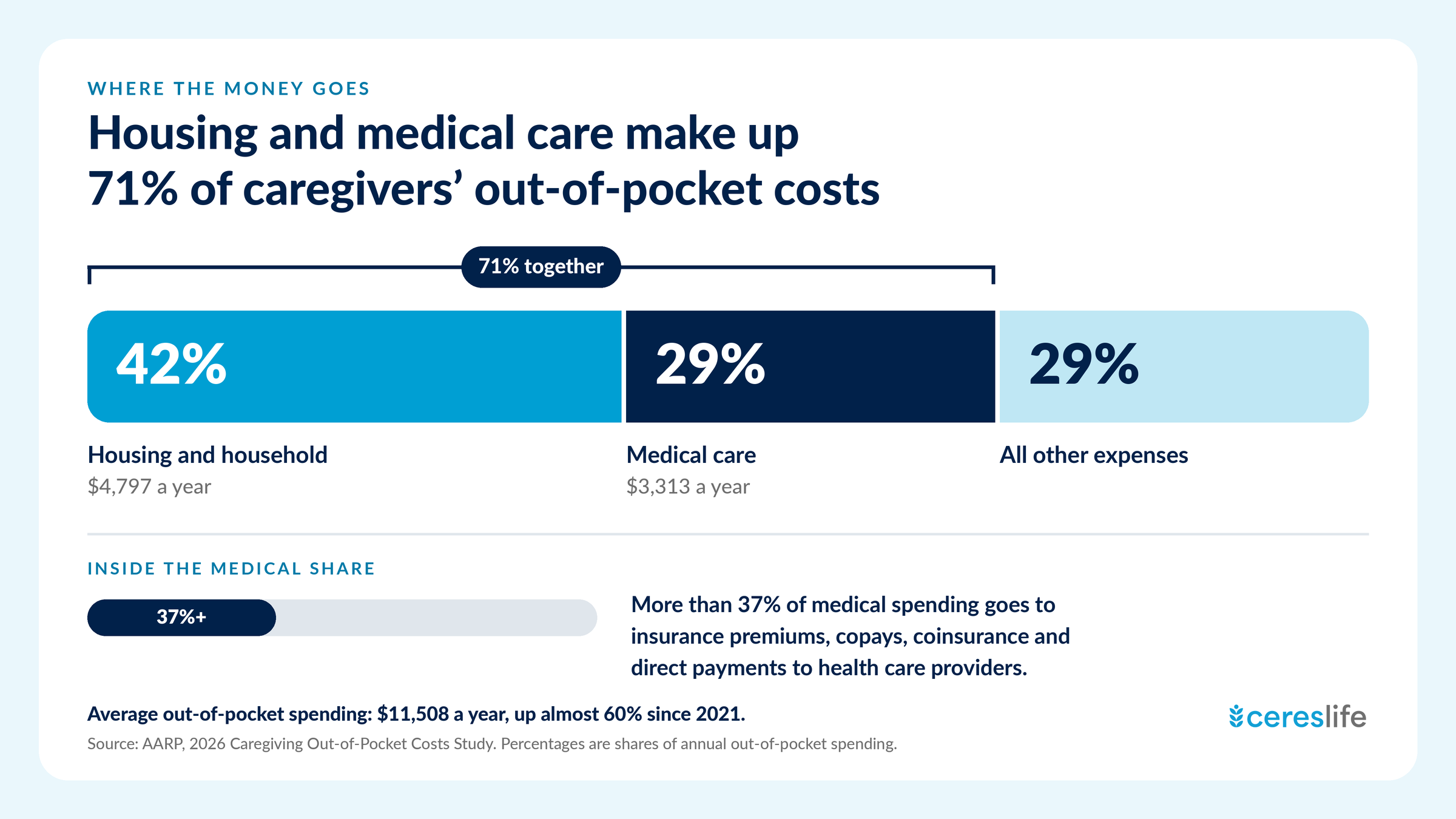
According to AARP's 2026 Caregiving Out-of-Pocket Costs Study, family caregivers spend an average of $11,508 a year of their own money on caregiving expenses, up nearly 60% from 2021. It also takes a big share of household budgets. On average, caregiving costs equal 31% of a caregiver's annual household income¹.
Where the money goes
The study found that housing and household expenses account for 42% of caregivers' out-of-pocket spending ($4,797 a year), and medical expenses account for another 29% ($3,313). Together, that's 71% of the total. Of the money spent on medical care, more than 37% goes toward insurance premiums, copays, coinsurance and direct payments to health care providers. In other words, healthcare is one of the two biggest line items, and the overall total has climbed sharply.
When you factor in other variables, like caring for someone with dementia or special needs, costs can increase. For example, the estimated cost of assisted living facility is $74,400 per year and a private nursing home national median is $129,575 per year².
Where you live also plays another role. Caregivers in the Mid-Atlantic (New York, New Jersey and Pennsylvania) spend an average of $15,845 a year, nearly twice the $7,955 spent in the West North Central region¹.
Why this matters for your retirement plan
Caregiving can affect retirement finances in two ways at once: more money going out, and potentially less coming in. Leaving work early or cutting back hours can mean fewer years of paychecks and savings, right when expenses are rising.
EBRI found that 56% of caregiving retirees retired earlier than planned, versus 44% of non-caregiving retirees, with women accounting for 61% of all caregivers³. Those who retired earlier than planned because of caregiving spent an average of $18,940 a year out of pocket, 64% more than the national average¹.
Ideas to consider
Build caregiving costs into your retirement budget. Healthcare in retirement isn't only about you. If you might help support a spouse, parent or other family member, consider that in your plan. Also keep in mind that Medicare generally doesn't cover most long-term care.
Think about dependable income. Income you can count on, such as Social Security, a pension and, for some people, an annuity with lifetime income features, can help cover predictable expenses and leave other savings for surprises.
Talk with family early. Conversations about care wishes, who can help and how costs might be shared are easier before a crisis.
Get personalized guidance. A financial professional can help you estimate how healthcare and care costs fit into your retirement income plan.
Retirement healthcare costs are rising, and for many families, caregiving makes the bill larger. Planning for that possibility now can help you feel more prepared later.
References
1: AARP’s 2026 Caregiving Out-of-Pocket Costs Study, October 28, 2026
2: Care Scout, The Cost of Care Survey, 2025
3: EBRI, Caregivers and Retirement: Findings from the 2026 Retirement Confidence Survey, July 22, 2026